
The next thing we’re building is better concrete.
A firm that has built for sixty years is now building the future of concrete itself — a patent-pending approach that delivers professional-grade strength in small quantities, with dramatically less cement.
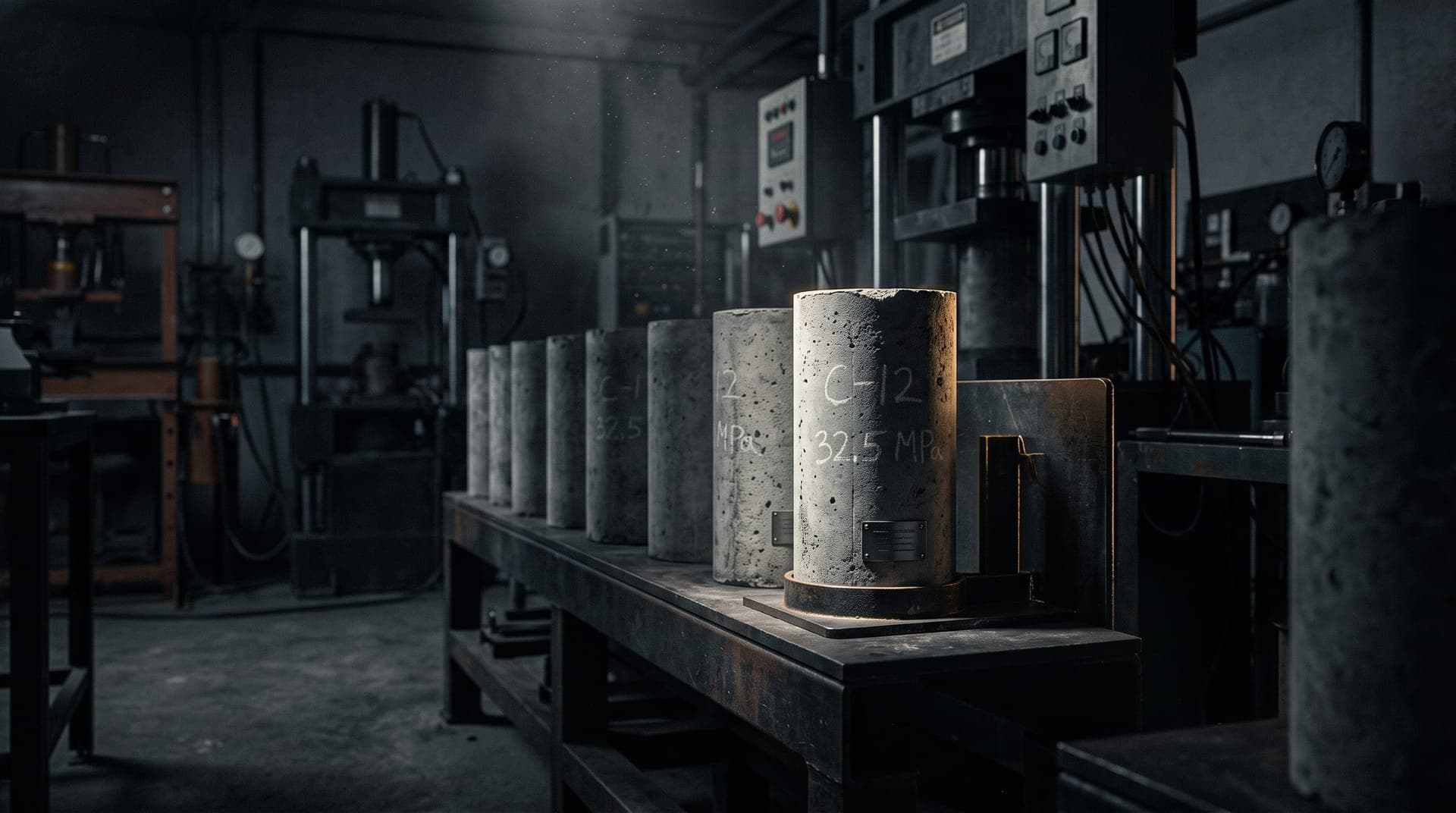
A gap between big supply and small need
Ready-Mix Concrete (RMC) is supplied only in large truckload volumes — typically 5–6 m³ or more.
Small jobs — a home extension, a boundary wall, a staircase, a small foundation — need just 0.25–1 m³.
So small builders mix concrete by hand on-site: quality becomes inconsistent and cement use spikes.
The volume gap
Conventional RMC starts at truckload sizes. Real small jobs need a fraction of that.
The firm that has built for sixty years is now building the future of concrete itself.
Cement per m³ for the same M25 strength
Illustrative figures from the inventor’s filing, comparing typical site-mixed practice with an optimised M25 mix design.
The same strength — with almost half the cement.
In practice, a professionally-designed M25 mix reaches full strength on roughly 270 kg of cement per cubic metre. The same strength site-mixed by hand often consumes close to 500 kg — nearly twice the cement for the same result.
Professional concrete, in the sizes small projects actually order.
Supply professionally-designed, quality-assured concrete in the small volumes real projects actually need — 0.25 to 1 m³ — so even the smallest job gets RMC-grade strength without over-using cement.
Cheaper to build, consistent in quality, kinder to the planet
≈230 kg less cement / m³
Equivalent strength with far less cement — because the mix is engineered, not guessed.
Lower cost to build
Cement is the most expensive ingredient in concrete. Use less of it and small builders save on every pour.
Consistent, predictable strength
Designed mixes replace on-site estimation — the same reliable M25 quality, every batch.
A real cut in CO₂
Cement is one of the largest industrial sources of carbon. Less cement per cubic metre means a measurably smaller footprint.
This low-cement concrete innovation is the subject of a patent application now being filed. This page shares the concept and its benefits; the specific mix design remains proprietary. Figures are illustrative, drawn from the inventor’s filing.
Want to build better — and greener?
If you're planning a small pour or a large project, talk to us about doing it with less cement and more certainty.